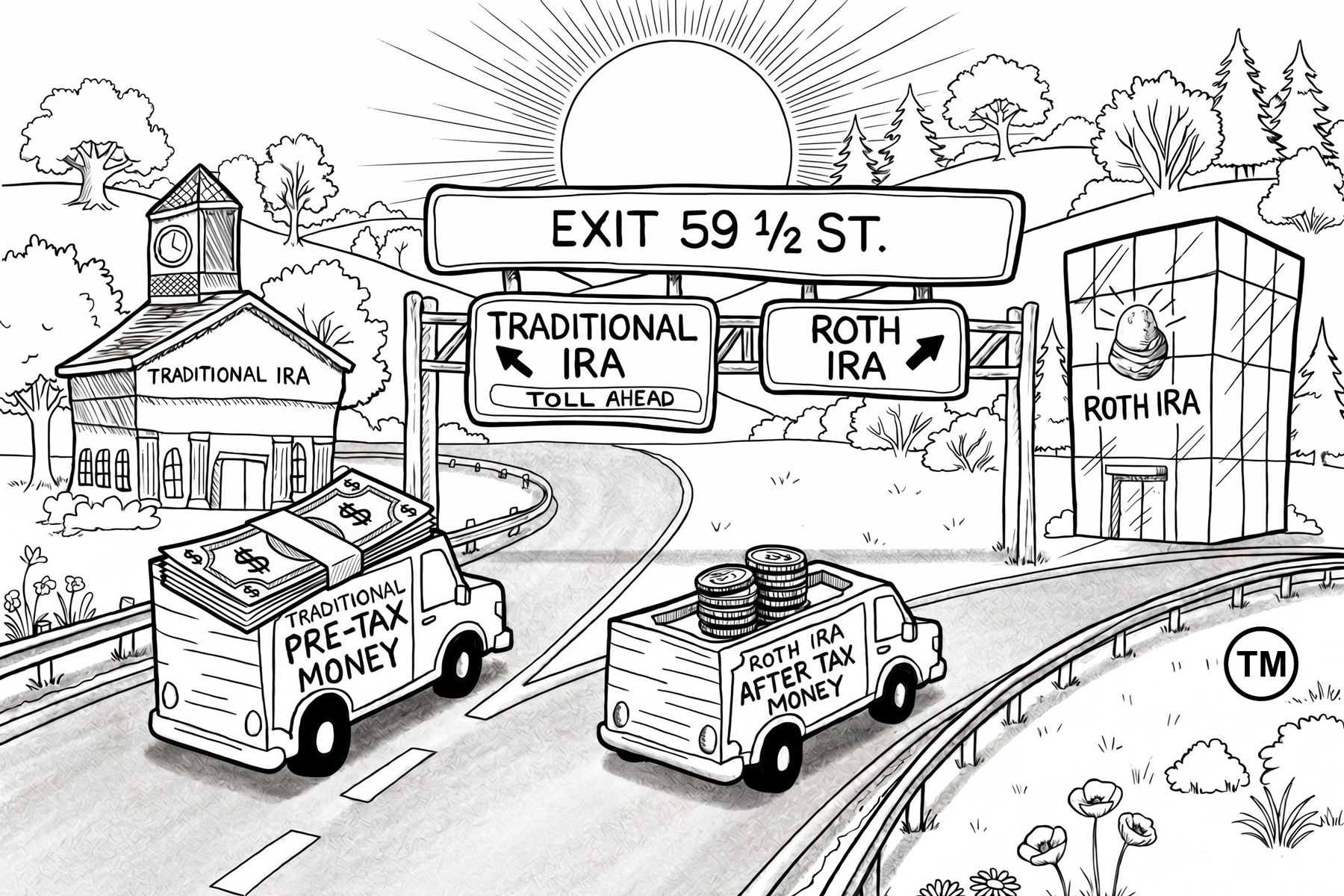
An Individual Retirement Account (IRA) is one of the most common tax-advantaged retirement savings accounts outside of employer-sponsored plans. But not all IRAs are the same. IRAs take two main forms: the traditional IRA and the Roth IRA. You may be trying to decide which type you want to invest in–or maybe even if you want to invest in both.
The main difference between a Roth IRA and a traditional IRA? How and when the tax break happens. A traditional IRA offers immediate tax break for contributions, while the tax benefits from a Roth IRA come later, with tax-free withdrawals.
The classic 401(k) retirement plan offered by most employers provides the same tax benefits as a traditional IRA. Some workplaces offer a Roth 401(k) option for employees; but if your workplace doesn’t offer the option, you may consider diverting some of your retirement savings dollars into a Roth IRA, which can provide more options for managing your tax burden in retirement.
If you can’t decide between a Roth IRA and a traditional IRA, many financial advisors suggest either splitting the difference or going with a Roth IRA, especially if you are not that close to retirement.
You can also choose to contribute to both a traditional and a Roth IRA during the same year, as long as the total amount does not exceed the IRS’s maximum allowable contribution limit, which is $7,500 for 2026 (or $8,600 if aged 50 and older).
Traditional IRA
Contributions to a traditional IRA are pretax and can’t exceed the amount of income you earned that year. You may be able to deduct some, or all, of your traditional IRA contributions.
Anyone with earned income can contribute to a traditional IRA. A spouse with low or no income may still be able to contribute to an IRA if that person is filing a joint tax return with a working spouse. The total amount contributed by both spouses can’t exceed their joint income or the IRS limits.
A minor with earned income can own and contribute to an IRA. The IRA is controlled by a parent or another adult, referred to as the custodian, until the minor reaches a certain age, typically 18 or 21. Income limits are based on the minor’s income, not the parents.
Contributions grow tax deferred. You will pay ordinary income tax on withdrawals of all traditional IRA earnings and on any contributions you originally deducted on your taxes.
Required Minimum Distributions (RMDs), a minimum amount you must withdraw from your tax-deferred retirement accounts each year are mandated by the IRS starting at a specific age. You must take your first RMD from your traditional IRA by April 1 of the year after you reach age 73 (or 72 for those born before July 1, 1949). For each subsequent year, you will need to take your annual RMD by December 31. In 2033, the age for beginning RMDs will increase to 75.
Roth IRA
Tax benefits for a Roth IRA come in the future with tax-free withdrawals. Contributions grow tax-free. Contributions are made after tax and can’t exceed the amount of income you earned that year. You can’t deduct your Roth IRA contribution.
Those with earned income below a certain level are eligible to contribute. For 2026, single-filers must have a Modified Adjusted Gross Income (MAGI) of less than $153,000, and joint-filers less than $242,000, to make a full contribution.
A spouse with low or no income may still be able to contribute to a Roth IRA if that person is filing a joint tax return with a working spouse. The total amount contributed by both spouses can’t exceed their joint income or the IRS limits.
A minor with earned income can own and contribute to a Roth IRA. The IRA is controlled by a parent or another adult, referred to as the custodian, until the minor reaches a certain age, typically 18 or 21. Income limits are based on the minor’s income, not the parents.
You will never pay taxes on withdrawals of your Roth IRA contributions, and you won’t pay taxes on withdrawals of your earnings as long as you take them after you have reached age 59½ and met the five-year holding-period requirement. There are no Required Minimum Distributions. Whatever money you don’t use can be passed to your beneficiaries tax-free in an inherited Roth IRA.
Making a Decision
Deciding whether a Roth IRA or traditional IRA (or both) is better for you depends on several factors:
- Current and expected future income levels: If you expect to be in a higher tax bracket in the future, a Roth IRA might be more beneficial as it offers tax-free withdrawals.
- Age and retirement timeline: Younger investors might prefer a Roth IRA to benefit from tax-free growth over a longer period.
- Tax-filing status and income: This determines eligibility for deductions (traditional IRA) or contributions (Roth IRA).
- Retirement goals and financial needs: Consider when you plan to access the funds and whether you will need the money before retirement.
As always, if you have any questions about this report or any other questions, please reach out to Bowen Asset at info@bowenasset.com or (610) 793-1001.
Disclaimer: While this article may concern an area of investing or investment strategy in which we supply advice to clients, this document is not intended to constitute a complete description of our investment services and is for informational purposes only. It is in no way a solicitation or an offer to sell securities or investment advisory services. Any statements regarding market or other financial information are obtained from sources which we and/or our suppliers believe to be reliable, but we do not warrant or guarantee the timeliness or accuracy of this information. All expressions of opinion reflect the judgement of the author on the date of publication and are subject to change.
Bowen Asset Management LLC is registered as an investment advisor and only transacts business in states where it is properly registered or is excluded or exempted from registration requirements. Past performance should not be taken as an indicator or guarantee of future performance, and no representation or warranty, express or implied, is made regarding future performance. As with any investment strategy or portion thereof, there is potential for profit as well as the possibility of loss. The price, value and income from investments mentioned in this report (if any) can fall as well as rise. To the extent that any financial projections are contained herein, such projections are dependent on the occurrence of future events, which cannot be predicted or assumed; therefore, the actual results achieved during the projection period, if applicable, may vary materially from the projections.