I’m forever blowing bubbles, pretty bubbles in the air.
They fly so high; nearly reach the sky.
Then, like my dreams, they fade and die.
Fortune’s always hiding; I’ve looked everywhere.
I’m forever blowing bubbles, pretty bubbles in the air.
–Kenbrovin & Kellette, 1919
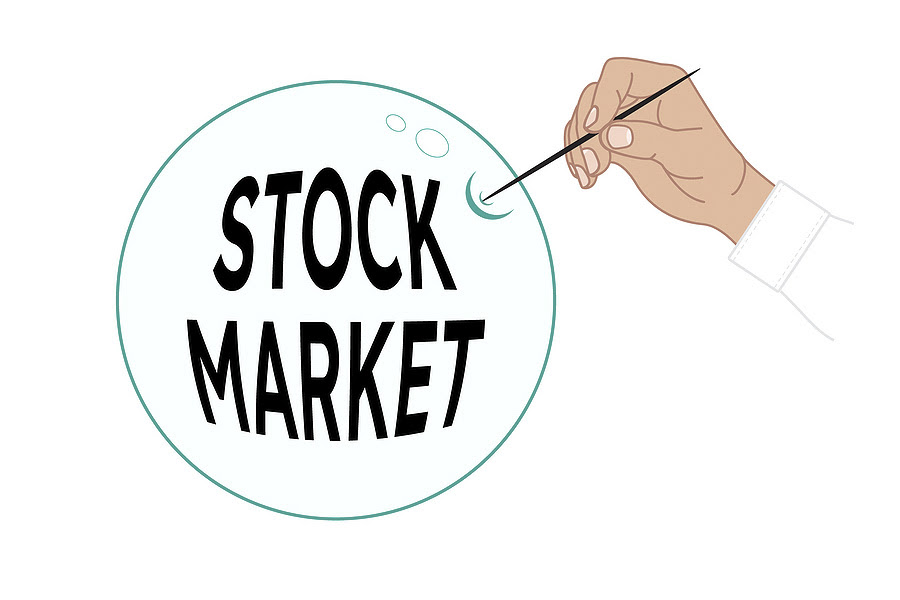
A market bubble is a rapid rise in the price of stocks or other assets that is not justified by fundamentals, followed by a sharp fall in prices once investor enthusiasm wanes. When the proponents of an overpriced asset go from touting its benefits to attacking its critics, you can be fairly sure it’s becoming a market bubble.
Bubbles are driven in large part by investor sentiment and psychology, which generate a positive feedback loop of rising prices and additional buying. As stock or other asset prices rise, more and more investors see the rising prices as an opportunity to profit. Further buying pushes prices even higher, which attracts more investors as the bubble inflates. Eventually, the bubble bursts when enough investors realize the price of the asset has become detached from its true value and all at once they rush to sell.
Here are some famous examples of market bubbles:
- “Tulip Mania” in 17th century Holland, the earliest recorded speculative bubble, in which the prices of rare, status-symbol tulip bulbs soared to extreme heights over the course of a few months (some of the most prized bulbs cost as much the price of a house) before collapsing abruptly.
- “The South Sea Bubble” in 18th century Britain, in which speculation over monopoly trading rights with South America in addition to insider trading drove South Sea Company shares up more than eightfold before crashing when the trading rights were revealed to be worthless.
- “The Wall Street Crash of 1929” in the United States, in which unchecked stock market speculation driven by a seemingly endless rise in post-war prosperity triggered a collapse that wiped out fortunes big and small, shook confidence in the banking system, and cascaded into the 1930s Great Depression.
- “The Dot-Com Bubble” in the late 1990s in the U.S., in which a lowering of the top marginal capital gains tax and a related increase in speculative venture-capital investments in internet-related startups (some with no tangible product or profits) inflated into multi-billion-dollar valuations before a sudden collapse in early 2000. During this time, a widespread belief emerged that the rise of technology had created a new economy in which the traditional business cycle and recessions no longer applied. These beliefs led to excessive risk-taking in both business and investing, as dot-com companies went public despite having negative earnings or extremely high valuations. When the bubble burst in 2000, the Nasdaq Composite Index dropped nearly 80% over the next two years.
- “The U.S. Housing Bubble” in the mid-2000s, in which uncontrolled mortgage lending and a boom in real-estate speculation triggered a wave of foreclosures that led to the financial crisis and Great Recession of 2008-09. For a time, it appeared that rising home values had created a new era of prosperity. In reality, the boom was built on the foundation of cheap money, expanding credit, and the widespread belief that housing prices could never fall. Home prices rose faster than incomes, mortgage lending standards collapsed, and speculation swept through every corner of the housing market. The bursting of the bubble ultimately triggered the crisis, in which subprime borrowers found it difficult to refinance while delinquencies and defaults soared, undermining the viability of subprime lending. When subprime lending collapsed, the demand for housing fell and home prices declined, exacerbating the squeeze on housing credit and reinforcing the downward pressure on housing prices. Banks overexposed to the mortgage derivatives market eventually had to be bailed out by the U.S. government to preserve the integrity of the global financial system.
When Does a Bull Turn into a Bubble?
A bull market is an extended period of rising stock prices and asset valuations driven by high investor optimism and leading to increased buying activity and higher risk tolerance. It is generally defined as a 20% or more increase in major market indexes (such as the S&P 500) from a recent low. In a bull market investors continue to constantly question high valuations, and demand is backed by solid earnings growth.
Market bubbles occur when those assets rise sharply without underlying fundamental justification, such as earnings growth, to justify those price gains. Investors are driven by fear of missing out and “irrational exuberance” (a phrase coined by then-Fed Chair Alan Greenspan during The Dot.Com Bubble) rather than considered, disciplined analysis. During the extreme heights of market bubbles, prices often continue to rise despite warning signs such as huge misses in earnings or sector analyst downgrades.
Recognizing a market bubble in real time and predicting when it will burst is very difficult, but there are certain red flags for investors to monitor. Bubbles are typically marked by a prevalent story, such as the idea that a new technology or new way of thinking has permanently transformed the market or that a rare opportunity to get in at the beginning of profitable enterprise is at hand.
In its early stages, a bubble’s growth is often self-reinforcing. The demand from the investment boom supports rapid profit growth, wider profit margins, and higher equity valuations. But on the downside, the feedback loop can run powerfully in reverse with a collapse in demand leading to a drop in cash flows and a reevaluation of the risks of lending to support the bubble’s further expansion.
During the euphoria stage of a market bubble, as noted, one of the psychological phenomena that drives accelerated buying is fear of missing out. This drives investors who might otherwise be uninterested in a particular stock or asset to feel compelled to invest when it appears others are making easy money in the market. Near the peak of a financial market bubble, it can feel to an outsider as if virtually every other investor is getting rich while everyone on the sidelines is missing out on the opportunity of a lifetime. In reality, this is the stage of the bubble when it is often the worst time to buy.
Bursting market bubbles can threaten the stability of the financial system or the economy, as investors witnessed during the bursting of the mortgage bubble in 2008 and 2009. Also, the extreme pricing volatility associated with bubbles can disillusion investors with the market in general, especially when it seems that asset prices have virtually no connection to real-world value.
Just because the price of the S&P 500 or another asset has appreciated significantly doesn’t necessarily mean the market is in a bubble. The S&P 500 has averaged an annual gain of a little more than 10% since 1926 and has more than tripled in the past decade. However, much of the S&P 500’s price appreciation in recent decades has been driven by underlying long-term earnings growth of its component companies.
Is AI Creating a Bull or a Bubble?
Economists, tech executives, and market analysts, are sharply divided on whether artificial intelligence (AI) is the next bubble.
Though early investment in AI spending was largely funded by internal cash flows, funding has increasingly shifted toward heavy debt, large credit commitments, and off-balance-sheet financing for data centers. The “Magnificent Seven” tech giants account for roughly a third of the S&P 500’s market capitalization, and some chipmakers trade at high multiples relative to immediate earnings.
Proponents of AI argue that current tech balance sheets and banking fundamentals are far stronger than during previous historical crises. Unlike the dot-com era of phantom startup companies, firms driving the current wave are massive, profitable entities generating real earnings. So-called “hyperscalers” such as Microsoft, Google, and Amazon spend tens of billions on data centers and the graphics processing units (GPU) which power AI by performing massive parallel processing, handling thousands of mathematical calculations at the same time. Data center and GPU orders remain heavily backlogged or sold out through upcoming years, indicating genuine enterprise and consumer demand.
Supporters of AI view the current capital expenditure as a multiyear “buildout” phase, similar to past electrical or internet infrastructure waves, where heavy upfront spending naturally precedes widespread, mature monetization.
However, some experts say, the focus as the investment cycle matures will shift to the returns that the hyperscalers are expected to earn on their massive investments. Until recently, AI companies were using free cash flow to finance growth. Now, most are raising debt to help finance the growth. It is easier to sink a chunk of cash into growth than a chunk of debt that needs to be paid back. The money being lent to finance data centers and other infrastructure needed for AI will look riskier as exposure grows and the growth rate decreases.
This is not to say that the companies raising the debt won’t be able to pay it back. However, because there is a time frame with respect to debt, the question is when the investors will see a return. As the growth in investment spending slows, the growth in earnings of suppliers to the hyperscalers will falter, profit expectations will diminish and price-earnings ratios will shrink. It will be difficult for the hyperscalers to generate sufficient revenue to realize the returns needed to justify an AI capital base.
The “picks and shovels” providers will suffer a double whammy—slower demand growth and profit margin compression. On the way up, higher demand leads to wider profit margins that sustain equity market valuations. On the way down, the outlook for earnings deteriorates quickly as the shortfall in demand relative to expectations is exacerbated by a collapse in profit margins.
If this small group of companies pushing genuine innovation forward nonetheless fall short, well-heeled investors backing them may dump their stocks at a loss. That could hinder the kind of consumer spending that can fuel an entire economy’s growth.
Conclusion: Check Your Bearings
Bubbles often become much bigger and last longer than anticipated because the expansion of the bubble sustains the investment and profit growth that led to the bubble in the first place. The beliefs of advocates are reinforced, while skeptics lose conviction and influence.
It is always a good idea to make sure your portfolio is diversified, holding not just the S&P 500, but smaller stocks and international stocks as well. You should also check whether you can rebalance—trimming some winning assets, such as large U.S. stocks, to add some recent laggards like bonds.
Although identifying bubbles in real time is challenging, awareness of market fundamentals and cautious investing during euphoric phases can mitigate risks associated with economic bubbles. No two bubbles are exactly alike. The most important thing is what remains after they pop.
As always, if you have any questions about this report or any other questions, please reach out to Bowen Asset at info@bowenasset.com or (610) 793-1001.
Disclaimer: While this article may concern an area of investing or investment strategy in which we supply advice to clients, this document is not intended to constitute a complete description of our investment services and is for informational purposes only. It is in no way a solicitation or an offer to sell securities or investment advisory services. Any statements regarding market or other financial information are obtained from sources which we and/or our suppliers believe to be reliable, but we do not warrant or guarantee the timeliness or accuracy of this information. All expressions of opinion reflect the judgement of the author on the date of publication and are subject to change.
Bowen Asset Management LLC is registered as an investment advisor and only transacts business in states where it is properly registered or is excluded or exempted from registration requirements. Past performance should not be taken as an indicator or guarantee of future performance, and no representation or warranty, express or implied, is made regarding future performance. As with any investment strategy or portion thereof, there is potential for profit as well as the possibility of loss. The price, value and income from investments mentioned in this report (if any) can fall as well as rise. To the extent that any financial projections are contained herein, such projections are dependent on the occurrence of future events, which cannot be predicted or assumed; therefore, the actual results achieved during the projection period, if applicable, may vary materially from the projections.