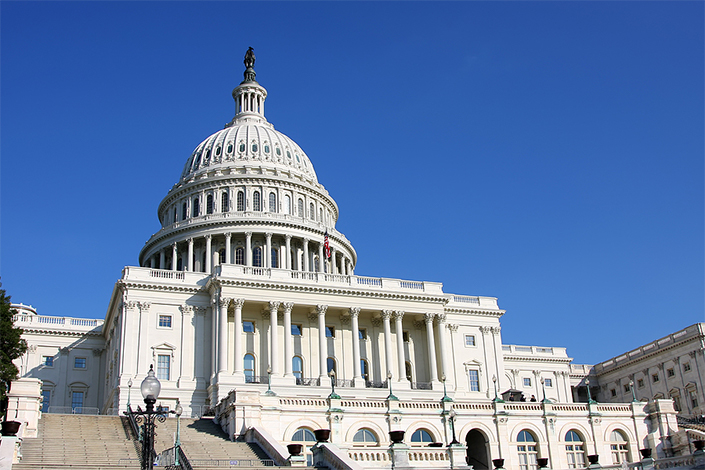
The Speaker of the House, currently Mike Johnson (R., Louisiana), is one of the most powerful elected positions in the federal government, the only position in Congress named in the Constitution, the second in line to the presidency after the vice president, and the point person for the legislative branch’s fundamental role in originating and passing laws. But little is spelled out in the Constitution about how the position works.
The original idea appeared to be for the Speaker of the House to serve as a parliamentarian along the lines of the Speaker in the British House of Commons, which is by convention a non-partisan position. In the United States, however, the convention is that the Speaker of the House is also the majority political party leader, representing partisan interests as well as serving as the body’s presiding officer and administrative head.
The Speaker plays a key role as negotiator between the House, the president, and the Senate. The Speaker controls the order of all institutional business on the House floor, by rule and custom, including determining what legislation will be brought up for a vote by the whole after passing through committee.
However, there is a way around the Speaker, called a discharge petition, in which a majority of the members of the House of Representatives (218 of 435) can force a vote to come to the floor without the Speaker’s agreement.
You may have heard a lot about this lately.
One high-profile discharge petition recently succeeded on a bill co-sponsored by Rep. Thomas Massie (R., Kentucky) and Rep. Ro Khanna (D., California) which demands that the Justice Department release all files related to the deceased financier and convicted pedophile sex offender Jeffrey Epstein.
A second discharge petition also succeeded on a bill co-sponsored by Rep. Jared Golden (D., Maine) and Rep. Brian Fitzpatrick, R., Pennsylvania), which would repeal a Trump administration executive order that stripped federal workers’ union rights.
It’s possible that using discharge petitions may become a regular process in the House.
How does a discharge petition work?
Playing by the Rule
First, let’s look at the method by which bills are usually brought to the floor.
A representative crafts and sponsors a bill. The bill is then assigned to a subcommittee for study. If released by the subcommittee, the bill is put on a calendar to be voted on, debated or amended. If the bill passes by simple majority (218 of 435), the bill moves on to the Senate.
This process is guided by the House Rules Committee — also referred to as the “speaker’s committee” — which is allied with the Speaker of the House and has a membership that skews heavily in the majority party’s favor. The Rules Committee is instrumental in recommending procedures for considering major bills and may propose restrictions on the floor amendments that members can offer or bar amendments altogether. So, legislation that comes through the Rules Committee is typically exactly what the majority leadership wants it to be.
Bills that make it out of the Rules Committee also come to the floor with certain debate parameters that must be fulfilled; this method enables those bills to pass the chamber with a simple majority. However, those debate parameters, called “the rule,” must also first be debated and voted on before the House can debate and vote on the underlying bill.
Bills that come directly to the House floor for a vote and bypass the Rules Committee are passed “under suspension of the rule” and require a two-thirds majority of the voting members to pass.
The House considers most legislation by motions to suspend the rules, with limited debate and no floor amendments, with the support of at least two-thirds of the members voting. Occasionally, the House will choose to consider a measure on the floor by unanimous consent of members.
Going Around the Rule
A discharge petition is a means of bringing a bill out of committee and to the floor for consideration without a report from the committee by “discharging” the committee from further consideration of a bill or resolution. Any member can file a discharge petition with the House clerk, who then makes it available in a “convenient place” for members to sign.
A House rule dating back to 1931 outlines the process. Basically, whenever the House is going to vote on a bill, they first must pass a “Special Rule” that says how they’re going to go about considering the bill, and then they can vote. So, discharging a Special Rule is the first step, but the goal is to pass the bill it is attached to.
Discharge petitions are rarely successfully used to force a vote on a contentious bill. This is because discharge petitions are typically used by the minority party on issues that can garner bipartisan support.
Currently, the most likely way for a discharge petition to be used in this Congress is for Democrats to try to force a vote on something that all Democrats and just a handful of Republicans wanted to force to the floor. But the only way for this to happen is if there is enough pressure on that handful of Republicans to break ranks from their party’s leadership.
A waiting period of seven legislative days kicks off once the petition gains the signatures of a majority of the chamber. After that, a member who has signed the petition can notify leadership that they’ll bring the discharge motion on the floor.
The speaker must then designate a time for the motion to be considered within two legislative days. If a majority approves it, the House then moves to consider the underlying measure.
The waiting periods, and the fact that garnering enough signatures can take weeks, often renders the maneuver somewhat futile for time-sensitive legislation. And a discharge petition can only be brought to the floor on specific days, further complicating its use.
The main reason discharge petitions are rarely successful is because a petition brought by the minority party requires members of the majority to buck their party leaders. In 2015, several dozen House Republicans joined with Democrats, who were in the minority, to reauthorize the Export-Import Bank. Before that, a discharge petition hadn’t succeeded since 2002.
In recent years, however, discharge petitions have met with more success. In 2024, a petition on a disaster relief tax bill received enough signatures, passed the House by a vote of 382 to 7 and the Senate by unanimous consent, and was signed into law by President Biden. In that same year, a second discharge petition brought forward a bill that eliminated existing provisions reducing Social Security benefits to some seniors, passed the House by a vote of 352 to 75, passed the Senate by a vote 76 to 20, and was signed into law by Biden.
As always, if you have any questions about this report or any other questions, please reach out to Bowen Asset at info@bowenasset.com or (610) 793-1001.
Disclaimer
While this article may concern an area of investing or investment strategy in which we supply advice to clients, this document is not intended to constitute a complete description of our investment services and is for informational purposes only. It is in no way a solicitation or an offer to sell securities or investment advisory services. Any statements regarding market or other financial information is obtained from sources which we and/or our suppliers believe to be reliable, but we do not warrant or guarantee the timeliness or accuracy of this information.
Past performance should not be taken as an indicator or guarantee of future performance, and no representation or warranty, express or implied, is made regarding future performance. As with any investment strategy or portion thereof, there is potential for profit as well as the possibility of loss. The price, value of and income from investments mentioned in this report (if any) can fall as well as rise. To the extent that any financial projections are contained herein, such projections are dependent on the occurrence of future events, which cannot be predicted or assumed; therefore, the actual results achieved during the projection period, if applicable, may vary materially from the projections.